Growth Audit — From Social Metrics to a Scalable Growth Model

Analyzed subscriber growth, churn and acquisition efficiency, identified a ~4.1× gap between the current growth rate and the business target, and built alternative scenarios for scaling growth without simply multiplying spend.
Context
The initial brief looked simple: grow the community from roughly 8K to 10K followers over four months.
The account was already acquiring followers and generating reach, but the existing net growth rate was not sufficient to hit the target.
The task therefore became a growth-efficiency problem: acquisition, unfollow dynamics, unit economics and scaling scenarios.
Client Data and Observed Baseline
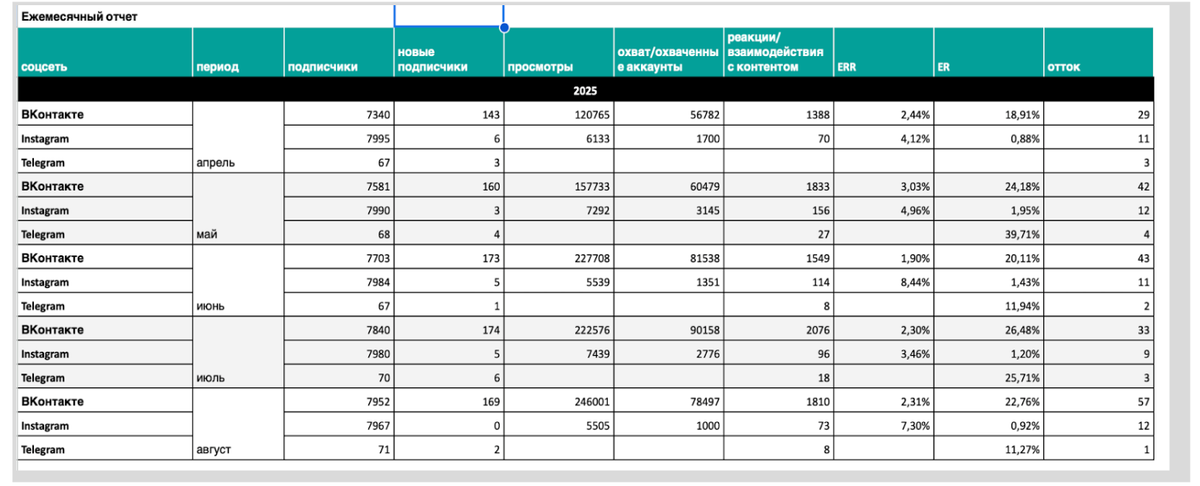
Across the analyzed period, VK added roughly 143-174 new followers per month while losing 29-57 followers to unfollows.
The business target required approximately 500 net new followers per month, compared with an observed average of ~123 — a ~4.1× growth gap.
OBSERVED GROWTH
| ~123/month | Current average net growth |
|---|---|
| ~500/month | Required net growth |
| ~4.1× | Growth gap |
Growth Leakage
Monthly unfollow volume was equivalent to approximately 19-34% of monthly new follower acquisition.
This showed that the problem was not only increasing acquisition volume, but improving the quality of the growth model.
Modeled Acquisition Economics
Using the client data, I calculated the acquisition economics and the effective cost of net audience growth after accounting for unfollow dynamics.
MODELED ECONOMICS
| ~150 RUB | CPM |
|---|---|
| ~25-35K RUB | Modeled monthly acquisition budget |
| ~170-190 RUB | Nominal CAC |
| ~230-250 RUB | Effective CAC |
Nominal follower acquisition cost was approximately RUB 170-190. After accounting for growth leakage, the effective cost of net audience growth increased to roughly RUB 230-250.
Scaling acquisition without improving the economics would therefore also scale inefficiency.
Growth Scenarios
Scenario A — Spend-Led Growth
Goal: reach roughly 500 net new followers per month primarily by increasing acquisition volume.
Current economics: nominal CAC ~170-190 RUB, effective CAC after growth leakage ~230-250 RUB.
Key risk: scaling acquisition would preserve the existing growth leakage inside the model.
Scenario B — Efficiency-Led Growth
The alternative scenario focused on improving acquisition efficiency, conversion to follow and unfollow dynamics before scaling traffic.
Recommendation
Do not scale acquisition first.
First improve acquisition efficiency, conversion and unfollow dynamics, then scale traffic against healthier unit economics.
The central management idea was to improve the economics of each acquired follower before increasing acquisition spend.
Modeled Target Scenario
TARGET MODEL
| 120-140 RUB | Target CAC |
|---|---|
| 15-18% | Target churn / unfollow level |
| ~450-550/month | Target net growth |
| ~25-35% | Potential CAC improvement |
The recommended model focused on improving unit economics before scaling traffic: targeting ~25-35% lower CAC, RUB 120-140 per acquired follower and ~450-550 net new followers per month.
These are target metrics from the growth model; actual post-implementation performance was not measured within the scope of the audit.
My Role
I worked as a growth consultant, analyzing acquisition and unfollow dynamics, reconstructing acquisition economics from the available data, identifying the gap between the current growth rate and the business target, and building alternative scaling scenarios.
My role was to turn an operational social-media goal into a measurable growth model with CAC, growth-leakage dynamics, scaling scenarios and clear decision criteria.
What This Project Demonstrates
This project demonstrates my approach to growth problems where the obvious answer — more traffic — is not necessarily the best one.
I use client data, growth analysis and unit economics to identify the real constraint, separate the observed baseline from modeled scenarios and turn marketing activity into a management decision.